
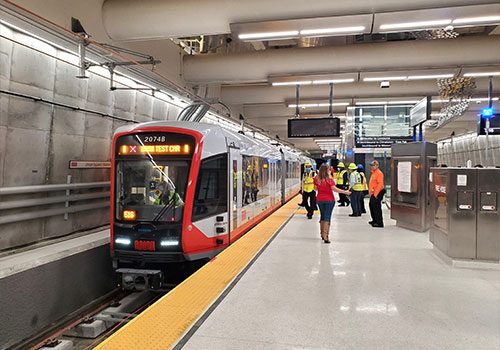
Underground Geolocation in the Service of Safety
Deep beneath the streets of the San Francisco metro system, a French technology is poised to transform the way operations staff and passengers interact with their environment. The Toulouse-based company Syntony GNSS, which specializes in geolocation solutions for complex environments within the Safran Group, has been selected to equip the tunnels of the SFMTA network with its SubWAVE solution, as part of the large-scale train control system modernization project (CBTC) led by Hitachi Rail.
An Invisible but Essential Technology
SubWAVE extends the coverage of GNSS systems (GPS, Galileo, etc.) into underground environments, where natural signals are unavailable. Using a hybrid architecture combining antennas and radiating cables, the technology ensures continuous and reliable positioning without requiring any modification to existing terminals. It is compatible with smartphones, professional radios, and onboard equipment.
“This project is a technological showcase for our expertise. SubWAVE makes the invisible visible: movements and the location of hazards in underground environments can be known in real time, improving collective safety and the efficiency of public transportation services,” emphasizes Joël Korsakissok, Founder of Syntony GNSS.
Enhanced Safety and Greater Comfort
The San Francisco metro carries nearly 160 million passengers each year across a 114-kilometer network combining historic streetcars and light rail. While geolocation services such as GNSS are available across most of the network, the 25 kilometers of underground track fall outside this natural coverage.
In this context, precise localization of staff and trains becomes a major challenge.
Once installed, SubWAVE will enable:
- Precise train positioning, improving traffic regulation and increasing network capacity by up to 20%, according to HITACHI projections.
- The prevention of collisions between trains, as well as with deployed staff, through interoperable onboard systems.
For passengers, continuous GNSS signal availability will facilitate navigation and access to connected services, even underground. An advancement that will smooth traffic flow and could inspire other metropolitan areas.
A Vital Issue in Emergency Situations
Immediate localization of emergency calls is another crucial contribution of the technology. According to the European Emergency Number Association (EENA), reducing emergency response time by one minute increases survival chances by 24%. By providing GNSS coverage, SubWAVE addresses this challenge by enabling emergency services to precisely locate calls, even those made from tunnels, allowing them to reach people in need much faster.
Industrial Recognition
Already deployed in several underground networks (public and private) around the world, SubWAVE technology confirms its status as a benchmark in the field. The San Francisco project, whose deployment will begin in 2027 with full commissioning planned for 2030, once again underscores the international issue that SubWAVE addresses.
Underground GNSS: a solution for many industries
Syntony GNSS works with major players in the underground sector, such as Stockholm metro operator SL, the Mont Blanc Tunnel, major mining companies, and specialized emergency services operating in confined environments (fire departments in particular) worldwide. Its expertise in underground geolocation is now emerging as a strategic lever for urban transportation operators and their partners.